Behaviour and Communication Framework
Looking Beyond What a Dog Does

Behaviour is often the first thing we notice.
We may see barking, growling, lunging, hiding, freezing, jumping, pulling, pacing or refusing to move.
It can be easy to focus only on stopping the behaviour.
The Behaviour Communication Framework encourages us to pause and consider what information the behaviour may be giving us.
Dogs communicate through their bodies, movement, facial expressions, sounds, distance-seeking behaviour, approach behaviour and changes in activity.
Behaviour may be influenced by emotion, physical health, pain, stress, previous experiences, learning, environment and relationships.
The framework does not claim that we can always know exactly what a dog is thinking or feeling.
Instead, it helps us observe more carefully, consider the wider context and respond with greater curiosity, compassion and care.
1. Observe
What Is the Dog Actually Doing?
The first step is to describe the behaviour as clearly and objectively as possible.
Instead of saying:
The dog was being aggressive.
We might describe what we observed:
The dog became still, closed their mouth, stared towards the person, growled and moved backwards.
Instead of saying:
The dog was being stubborn.
We might say:
The dog stopped walking, lowered their body and turned their head away.
Clear observation helps us separate what happened from the meaning we may have attached to it.
Questions to consider
- What did the dog’s body do?
- What changed in their posture?
- Were they moving towards or away from something?
- Did they become more still or more active?
- What sounds did they make?
- What happened immediately before the behaviour changed?
- How long did the behaviour last?
Observation gives us the starting point for understanding.
2. Context

Where and When Did It Happen?
Behaviour does not occur in isolation.
The same dog may respond differently depending on the environment, distance, people present, level of noise, previous events and how they are feeling that day.
A dog may appear relaxed around visitors outdoors but struggle when visitors enter the home.
A dog may cope with another dog at a distance but become overwhelmed when the distance becomes smaller.
Understanding the context helps us avoid treating one moment as though it tells us everything about the dog.
Questions to consider
- Where did the behaviour happen?
- Who or what was present?
- What happened immediately beforehand?
- How close was the dog to the trigger?
- Was the dog able to move away?
- Was the environment busy, noisy or unfamiliar?
- Had anything stressful happened earlier?
- Does the behaviour happen in other situations?
Context helps us recognise patterns.
3. Communication
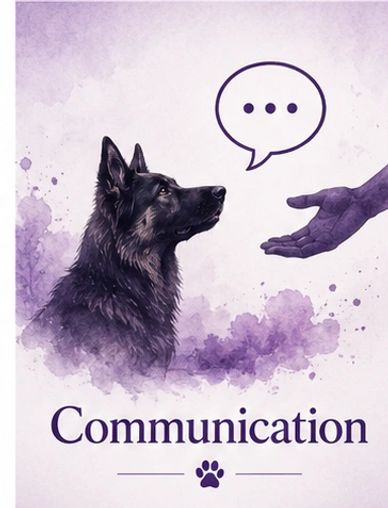
What Information Might the Behaviour Be Giving Us?
Behaviour may communicate a range of needs, experiences or intentions.
A dog may be trying to:
- create distance;
- gain access;
- avoid something;
- seek reassurance;
- protect something important;
- invite interaction;
- end an interaction;
- express discomfort;
- cope with uncertainty;
- release excitement or frustration.
Communication does not always mean the dog is making a deliberate, planned choice.
Behaviour can also be an automatic response to emotion, arousal, pain or previous learning.
We should remain open to several possible explanations rather than deciding too quickly that we know exactly what the dog means.
Questions to consider
- Is the dog trying to move closer or further away?
- Are they seeking access to something?
- Are they trying to stop an interaction?
- Are they asking for space?
- Are they seeking connection or reassurance?
- Has this behaviour helped them in similar situations before?
Behaviour gives us information, even when the full meaning is not immediately clear.
4. Emotion

How Might the Dog Be Feeling?
Emotions influence behaviour.
Dogs may experience fear, anxiety, frustration, excitement, uncertainty, conflict, relief, pleasure and distress.
A dog who is frightened may freeze, hide, bark, growl, lunge or attempt to escape.
A dog who is frustrated may pull, vocalise, jump or struggle to disengage.
A dog who feels conflicted may move forwards and backwards, approach and retreat, or show several different signals close together.
We cannot ask a dog to describe their emotional experience, so our interpretation must remain careful and open-minded.
Questions to consider
- Does the dog appear relaxed or tense?
- Are they trying to avoid or escape?
- Are they highly excited or unable to settle?
- Are there signs of fear, frustration or uncertainty?
- Does the dog appear conflicted?
- How quickly do they recover afterwards?
Considering emotion helps us respond to the dog’s experience, not only the visible behaviour.
5. Influences
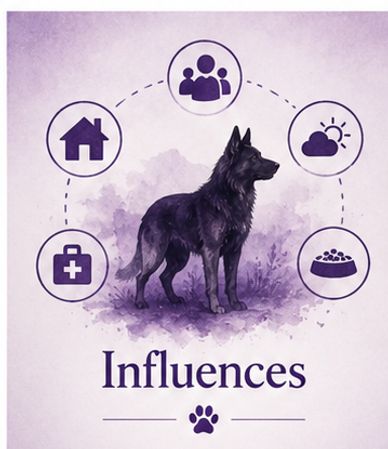
What Else May Be Contributing?
Behaviour can be influenced by many interacting factors.
These may include:
- pain or physical discomfort;
- illness;
- tiredness;
- lack of sleep;
- hunger or thirst;
- hormonal changes;
- stress;
- previous experiences;
- learning history;
- environment;
- lack of choice;
- unsuitable expectations;
- relationships;
- changes in routine;
- sensory sensitivity.
A sudden change in behaviour should never automatically be treated as a training issue.
Physical health and pain should always be considered, especially when behaviour is new, worsening or appears during touch, movement or rest.
Questions to consider
- Is this behaviour new or different?
- Could pain or discomfort be involved?
- Has the dog had enough sleep and recovery?
- Has their routine recently changed?
- Has the behaviour been reinforced previously?
- Does the environment make coping difficult?
- Are expectations realistic for this individual dog?
Looking at influences helps us consider the whole dog.
6. Response
What Happened After the Behaviour?
What happens after behaviour can influence what the dog learns.
For example, if a dog barks and another dog moves away, barking may have successfully created distance.
If a dog jumps and receives attention, jumping may become more likely in similar situations.
This does not mean the behaviour is simply manipulative or deliberate.
It means that consequences can shape future behaviour, alongside emotion, context and individual experience.
Our own responses also matter.
Shouting, pulling, confronting or continuing to apply pressure may increase fear, frustration or conflict.
Questions to consider
- What happened immediately after the behaviour?
- Did the dog gain space, access or attention?
- Did something difficult stop?
- How did the people present respond?
- Did the dog become calmer or more distressed?
- Could the response have increased pressure?
Understanding the response can help us make safer and more supportive choices next time.
7. Support
7. Support
7. Support

What Could Help Next?
Once we have considered the behaviour, context, communication, emotion, influences and response, we can begin thinking about appropriate support.
Support may include:
- creating more distance;
- reducing pressure;
- changing the environment;
- allowing more rest;
- using barriers;
- adjusting routines;
- preventing overwhelming situations;
- teaching alternative skills;
- offering more choice;
- seeking veterinary advice;
- working with a qualified behaviour professional.
The aim is not simply to suppress the behaviour.
The aim is to help the dog feel safer, cope more successfully and reduce the factors contributing to the behaviour.
Questions to consider
- What can be changed immediately?
- Can the dog be given more distance or choice?
- Is management needed?
- Is the situation safe?
- Does the dog need veterinary assessment?
- Is professional behaviour support appropriate?
- What would reduce the likelihood of the dog becoming overwhelmed again?
Support should be shaped around the individual dog.