The Behaviour Assessment Framework

Building a Fuller Picture of Behaviour
Behaviour concerns are rarely explained by one factor alone.
What we see may be influenced by physical health, pain, emotions, stress, previous learning, everyday life, relationships and the environment around the dog.
The Behaviour Assessment Framework helps us slow down, gather relevant information and organise what we know before reaching conclusions.
It encourages us to move away from quick labels and consider the whole dog.
This framework is designed for education and reflection. It does not provide a diagnosis or replace veterinary assessment or qualified professional behaviour support.
Understanding the Behaviour
Presenting Behaviour
Presenting Behaviour
Presenting Behaviour
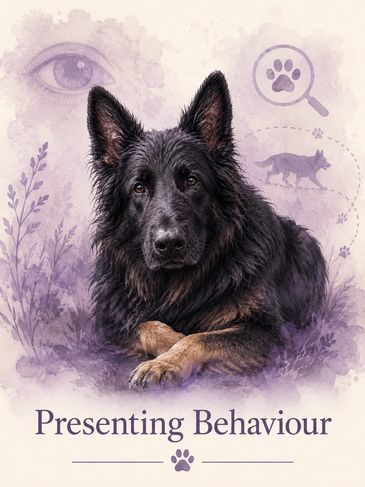
What is happening?
Begin by describing what can actually be observed rather than relying on labels such as aggressive, reactive, stubborn or anxious.
Consider:
- what the dog does;
- how often it happens;
- how long it lasts;
- how intense it appears;
- how quickly the dog recovers;
- whether the behaviour is changing.
Clear descriptions help reduce assumpti
What is happening?
Begin by describing what can actually be observed rather than relying on labels such as aggressive, reactive, stubborn or anxious.
Consider:
- what the dog does;
- how often it happens;
- how long it lasts;
- how intense it appears;
- how quickly the dog recovers;
- whether the behaviour is changing.
Clear descriptions help reduce assumptions and provide a stronger starting point for understanding.
![Cover of context and patterns] by Seeing Dogs Differently.](http://img1.wsimg.com/isteam/ip/3dedec3c-8d80-4130-844c-8e0b42934841/cp.png/:/cr=t:2.17%25,l:0%25,w:97.83%25,h:97.83%25/rs=w:365,cg:true,m)
Context and Patterns
Presenting Behaviour
Presenting Behaviour
When, where and with whom does it happen?
Behaviour often follows patterns.
A dog may struggle in certain places, around particular people or animals, at specific distances, during busy periods or after stressful experiences.
Consider:
- where the behaviour occurs;
- who or what is present;
- what usually happens beforehand;
- whether distance affects
When, where and with whom does it happen?
Behaviour often follows patterns.
A dog may struggle in certain places, around particular people or animals, at specific distances, during busy periods or after stressful experiences.
Consider:
- where the behaviour occurs;
- who or what is present;
- what usually happens beforehand;
- whether distance affects the response;
- whether the dog copes better in other situations;
- whether tiredness, stress or changes in routine influence the behaviour.
Patterns can reveal what makes a response more or less likely.
Physical Health
Presenting Behaviour
Physical Health
Could pain, illness or discomfort be involved?
Physical health can significantly affect behaviour.
Pain, illness and discomfort may influence tolerance, movement, sleep, appetite, touch sensitivity, social interaction and the ability to cope.
Veterinary advice may be especially important when behaviour:
- begins suddenly;
- changes without an obv
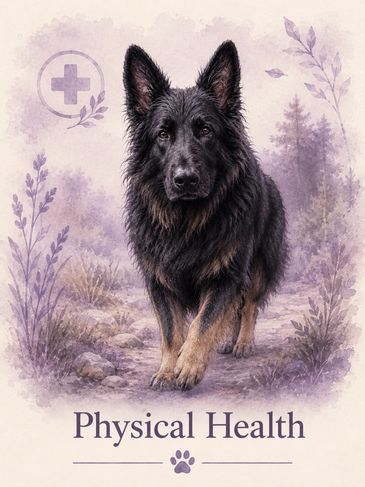
Could pain, illness or discomfort be involved?
Physical health can significantly affect behaviour.
Pain, illness and discomfort may influence tolerance, movement, sleep, appetite, touch sensitivity, social interaction and the ability to cope.
Veterinary advice may be especially important when behaviour:
- begins suddenly;
- changes without an obvious reason;
- occurs during touch or movement;
- appears alongside changes in sleep, appetite or activity;
- becomes more noticeable after exercise;
- involves something the dog previously tolerated.
Changes in behaviour should not automatically be treated as training problems.

Emotional State
History and Learning
Physical Health
How might the dog be feeling?
Behaviour is closely connected to emotion.
A dog may be experiencing fear, anxiety, frustration, excitement, uncertainty, conflict or distress.
Look at the dog’s overall communication, including:
- posture and movement;
- facial tension;
- breathing;
- vocalisation;
- attempts to create distance;
- ability to eat or explore;
- reco
How might the dog be feeling?
Behaviour is closely connected to emotion.
A dog may be experiencing fear, anxiety, frustration, excitement, uncertainty, conflict or distress.
Look at the dog’s overall communication, including:
- posture and movement;
- facial tension;
- breathing;
- vocalisation;
- attempts to create distance;
- ability to eat or explore;
- recovery after the event.
The important question is not simply, “How do we stop the behaviour?” but also, “Does this dog feel safe?”

History and Learning
History and Learning
History and Learning
What has the dog experienced and learned?
Previous experiences can influence present behaviour.
Relevant history may include early development, social experiences, training methods, frightening events, previous injuries, rehoming, repeated exposure to triggers and what has happened after the behaviour.
Behaviour that creates a useful outcom
What has the dog experienced and learned?
Previous experiences can influence present behaviour.
Relevant history may include early development, social experiences, training methods, frightening events, previous injuries, rehoming, repeated exposure to triggers and what has happened after the behaviour.
Behaviour that creates a useful outcome may become more likely.
For example, when growling causes someone to move away, the dog may learn that growling successfully creates space.
This does not mean the dog is being manipulative. It means the outcome has influenced future behaviour.
History helps us understand how the present response may have developed.
Understanding the Dog’s World

Lifestyle and Environment
Lifestyle and Environment
Lifestyle and Environment
Does everyday life support the dog?
A dog’s daily life can either support their ability to cope or place them under additional pressure.
Consider:
- sleep and rest;
- routine and predictability;
- exercise and enrichment;
- opportunities to sniff and explore;
- time alone;
- household noise and activity;
- access to quiet spaces;
- choice and control;
- repeated exp
Does everyday life support the dog?
A dog’s daily life can either support their ability to cope or place them under additional pressure.
Consider:
- sleep and rest;
- routine and predictability;
- exercise and enrichment;
- opportunities to sniff and explore;
- time alone;
- household noise and activity;
- access to quiet spaces;
- choice and control;
- repeated exposure to stressful situations.
More activity is not always the answer. Some dogs need fewer overwhelming experiences and more opportunities to rest and recover.
Relationships
Lifestyle and Environment
Lifestyle and Environment
How do interactions affect the situation?
Dogs live within relationships.
Their behaviour may be influenced by family members, children, visitors, other animals, professionals and unfamiliar people.
Different people may respond to the dog in different ways. Inconsistent expectations, pressure, confrontation or misunderstanding can increase
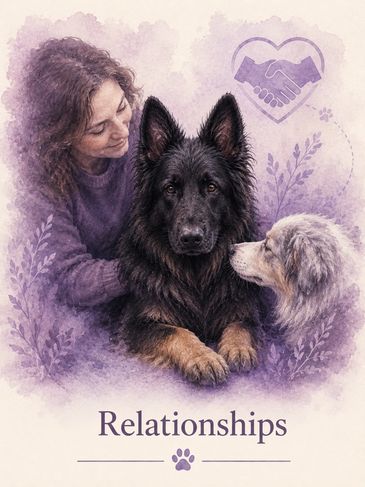
How do interactions affect the situation?
Dogs live within relationships.
Their behaviour may be influenced by family members, children, visitors, other animals, professionals and unfamiliar people.
Different people may respond to the dog in different ways. Inconsistent expectations, pressure, confrontation or misunderstanding can increase difficulty.
Relationships can also provide safety, predictability and trust.
Consider whether the dog is listened to, given space when needed and supported consistently by the people around them.
Risk and Safety
Lifestyle and Environment
Risk and Safety
Is anyone at risk?
Understanding why behaviour occurs does not remove the need to protect dogs and people.
Some situations require immediate safety planning, particularly where there are:
- bites or attempted bites;
- escalating aggressive behaviour;
- conflict between animals;
- children or vulnerable people;
- chasing or escaping;
- traffic risks;
- access t
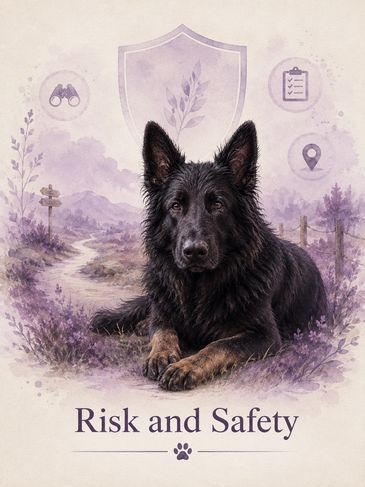
Is anyone at risk?
Understanding why behaviour occurs does not remove the need to protect dogs and people.
Some situations require immediate safety planning, particularly where there are:
- bites or attempted bites;
- escalating aggressive behaviour;
- conflict between animals;
- children or vulnerable people;
- chasing or escaping;
- traffic risks;
- access to dangerous items;
- severe distress.
Safety decisions should consider what has happened, who may be exposed, the possible consequences and whether the situation can be managed reliably.
Urgent professional support may be needed when there is a risk of injury or the situation cannot be managed safely.
Planning Support
Management
Next Support
Next Support
What can be changed now?
Management reduces the likelihood of difficult or dangerous situations while further support is arranged.
This might include:
- using barriers or separation;
- creating more distance;
- changing walking routes;
- adjusting routines;
- preventing unsupervised contact;
- providing quiet spaces;
- avoiding overwhelming situations;
- control
What can be changed now?
Management reduces the likelihood of difficult or dangerous situations while further support is arranged.
This might include:
- using barriers or separation;
- creating more distance;
- changing walking routes;
- adjusting routines;
- preventing unsupervised contact;
- providing quiet spaces;
- avoiding overwhelming situations;
- controlling access to valued resources;
- improving supervision.
Management is not failure.
It is a responsible and welfare-focused way to protect the dog and the people or animals around them.
Next Support
Next Support
Next Support
What help may be appropriate?
The information gathered through the framework can help identify the most suitable next step.
This may include:
- veterinary assessment;
- investigation of possible pain or illness;
- environmental or routine changes;
- further observation;
- support from a qualified dog trainer;
- referral to a qualified behaviour professiona
What help may be appropriate?
The information gathered through the framework can help identify the most suitable next step.
This may include:
- veterinary assessment;
- investigation of possible pain or illness;
- environmental or routine changes;
- further observation;
- support from a qualified dog trainer;
- referral to a qualified behaviour professional;
- specialist support;
- practical support for the family.
Not every behaviour concern requires the same response.
Training may help with skill development. Behaviour support may be needed when fear, anxiety, aggression or complex emotional factors are involved. Veterinary involvement may be essential when health or pain could be contributing.
Seeking the right support is part of responsible care.